
Sales Inquiry

The Role of Forging in Automotive and Aerospace Industries

April 16, 2026
Forging in Automotive and Aerospace Industries is recognized as a cornerstone of modern manufacturing, providing the superior structural integrity and fatigue resistance required for high-stress applications. Through the controlled deformation of metal under extreme pressure, components are produced with refined grain structures that satisfy the most stringent safety and performance standards in the global transport sectors.
The Fundamental Role of Forging in Modern Engineering
The manufacturing landscape is underpinned by the forging process, a method where metal is shaped using localized compressive forces. In the context of heavy industry, forging is not merely a shaping technique; it is a metallurgical necessity. Unlike casting or machining from solid stock, the forging process is characterized by the alignment of the metal’s grain flow to the shape of the part. Consequently, mechanical properties are enhanced, and the risk of internal defects is virtually eliminated.
For organizations like IQS Engineering, the mastery of these processes is essential. As global demands for fuel efficiency and vehicle safety increase, the reliance on high strength forged components becomes more pronounced. Whether it is a high-speed racing engine or a commercial airliner, the reliability of the system is often dependent on a single forged component.
Forging in the Automotive Industry: Driving Performance and Safety
The automotive sector remains one of the largest consumers of forged metal. In this industry, the balance between weight reduction and structural durability is constantly sought. Forged parts in the automotive industry are favored because they provide a higher strength-to-weight ratio compared to cast alternatives.
Critical Automotive Forging Components
Several mission-critical parts are manufactured through forging to ensure vehicle longevity:
- Powertrain Components: Crankshafts, connecting rods, and camshafts are forged to withstand the intense thermal and mechanical stresses of internal combustion.
- Drivetrain Parts: Transmission gears, differential gears, and clutch hubs are produced via forging to handle high torque loads.
- Chassis and Suspension: Steering knuckles, ball joints, and wheel hubs are forged to ensure that steering integrity is maintained even under extreme road conditions.
The benefits of forging in the automotive sector extend beyond mere strength. Because forged parts are more predictable in their response to heat treatment, a higher degree of consistency is achieved during mass production. This reliability is vital for the "Just-In-Time" manufacturing models used by major OEMs.
Materials and Precision Forging
The forging process for automotive parts typically utilizes carbon and alloy steels. However, as the industry shifts toward electric vehicles (EVs), aluminum forging is increasingly utilized to offset the weight of heavy battery packs. Through precision forging, the need for secondary machining is reduced, which results in significant cost savings and material efficiency.
Aerospace Forging: Engineering for Extreme Conditions
In the aerospace sector, the margin for error is non-existent. Aerospace forging applications require materials that can maintain structural integrity while being subjected to extreme temperature fluctuations and corrosive environments.
Key Aerospace Forged Components Manufacturing
The complexity of aerospace engineering demands the use of advanced alloys, including titanium, nickel-based superalloys, and high-strength aluminum.
- Engine Components: Turbine disks, compressor blades, and fan hubs are forged to endure high rotational speeds and intense heat.
- Structural Airframe Parts: Wing spars, bulkheads, and engine mounts are manufactured to provide the primary "skeleton" of the aircraft.
- Landing Gear: Perhaps the most critical application, landing gear cylinders and struts are forged to absorb the massive impact forces during touchdown.
Precision forging in the aerospace industry is often executed under vacuum conditions or within strictly controlled thermal envelopes. This ensures that the metallurgical "recipe" of the alloy is not compromised during the shaping process.
Closed Die Forging for Aerospace
For complex geometries, closed die forging for aerospace is the preferred methodology. In this process, the metal is compressed within a cavity that represents the final shape of the part. This ensures that the grain flow is contoured specifically to the component’s functional requirements, providing maximum resistance to fatigue and stress corrosion cracking.
Technical Comparison: Forging Methodologies
To understand how these sectors select their manufacturing paths, a comparison of the two primary forging types is required.
| Feature | Open Die Forging | Closed Die (Impression) Forging |
|---|---|---|
| Process | Metal is compressed between flat or simple shaped dies. | Metal is trapped within a custom-shaped die cavity. |
| Typical Size | Suited for very large, heavy components. | Suited for smaller, high-precision parts. |
| Complexity | Produces simple, functional shapes. | Produces complex, near-net-shape geometries. |
| Common Use | Large shafts, rings, and cylinders. | Gears, connecting rods, and turbine blades. |
| Material Waste | Higher; requires more secondary machining. | Lower; highly efficient material usage. |
Strategic Benefits of the Forging Process
Scientific studies and industrial data confirm that forging provides distinct advantages over alternative fabrication methods such as casting or additive manufacturing.
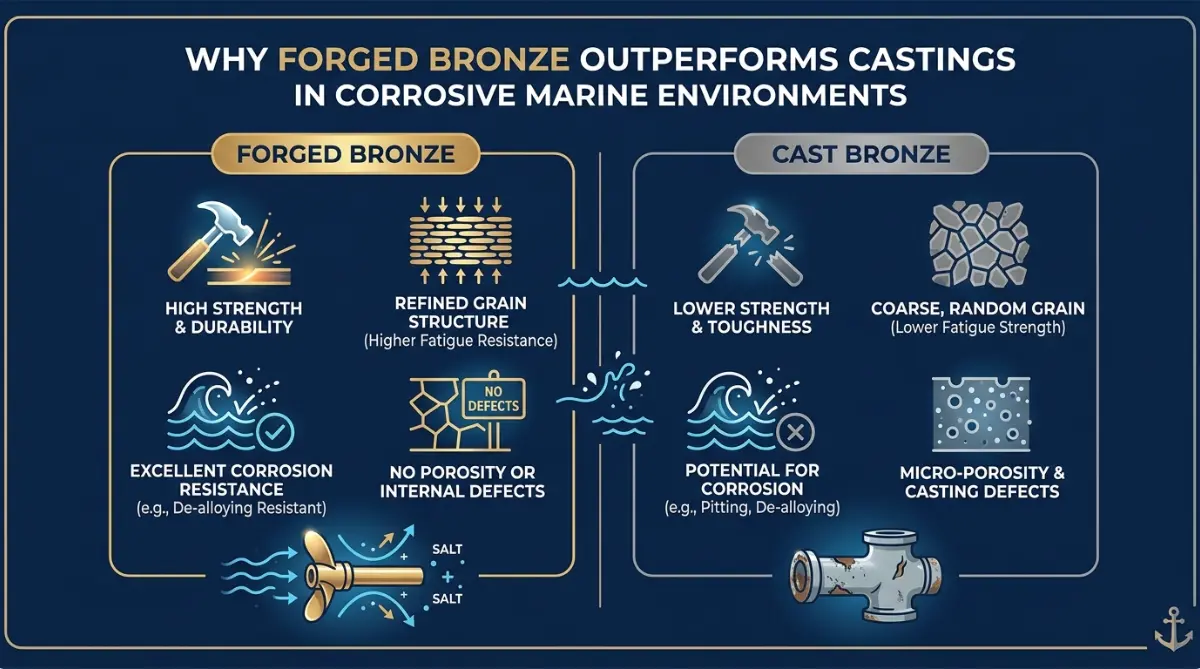
- Structural Integrity: Internal voids and gas pockets, which are common in casting, are eliminated by the compressive forces of forging.
- Enhanced Fatigue Life: The directional grain flow created during forging acts as a reinforcement against crack propagation.
- Weight Optimization: Because the material is inherently stronger, thinner and lighter sections can be designed without sacrificing safety.
- Heat Treat Response: Forged materials respond more uniformly to thermal processing, ensuring that hardness and ductility are consistent throughout the part.
The Evolution of Forging: Industry 4.0 and Sustainability
The future of Forging in Automotive and Aerospace Industries is being shaped by digital transformation. "Smart Forging" involves the use of sensors and AI-driven simulation software to predict metal flow and heat distribution before a single hammer is dropped.
Furthermore, sustainability is being prioritized. Forging is inherently a "green" process compared to others; because near-net-shape forging reduces the volume of scrap metal produced, the carbon footprint of the manufacturing cycle is lowered. At IQS Engineering, the integration of these advanced technologies ensures that components are not only stronger but also produced with maximum resource efficiency.
Frequently Asked Questions (FAQ)
1. Why is forging preferred over casting for automotive safety parts?
Forging is preferred because it eliminates internal porosity and creates a continuous grain flow. This results in much higher impact strength and fatigue resistance, which is essential for components like steering knuckles and axle beams.
2. What are the most common materials used in aerospace forging?
High-strength aluminum alloys, titanium (Ti-6Al-4V), and nickel-based superalloys (such as Inconel) are the primary materials. These are chosen for their ability to maintain strength at high temperatures and their resistance to corrosion.
3. How does forging contribute to fuel efficiency in vehicles?
Through the use of high-strength forged aluminum and micro-alloyed steels, parts can be designed with less mass while maintaining the same structural capacity. Lighter vehicles require less energy to move, directly improving fuel economy and reducing emissions.
4. What is the difference between hot forging and cold forging?
Hot forging is performed at temperatures above the metal's recrystallization point, allowing for massive deformation of large parts. Cold forging is performed at room temperature, providing exceptional surface finish and dimensional accuracy for smaller components.
5. Is forging compatible with modern AI and automation?
Yes. Modern forging facilities use automated robotic arms for part handling and AI-based thermal imaging to ensure each piece is forged within the optimal temperature window, ensuring 100% quality repeatability.
Partner with the Experts in Precision Engineering
As the demands of the automotive and aerospace sectors evolve, the need for high-quality, reliable forged components becomes paramount. IQS Engineering provides the technical expertise and manufacturing excellence required to power the next generation of transport technology.