
Sales Inquiry

Applications of Brass Forged Components in Electrical & Earthing Accessories
April 6, 2026
High-performance power distribution systems require materials that successfully balance electrical conductivity with superior mechanical durability to ensure long-term safety. These stringent engineering requirements are consistently met through the integration of Brass Forged Components, which are valued for their dense, grain-refined structure and ability to withstand high-stress electrical environments. By utilizing the hot forging process, non-ferrous alloys are transformed into high-conductivity parts that serve as the backbone of modern grounding and power management infrastructure.
The Metallurgical Superiority of Forged Brass in Electronics
In the field of electrical engineering, the choice of material is dictated by the alloy's ability to facilitate electron flow while resisting physical deformation. Brass, an alloy primarily composed of copper and zinc, is frequently selected due to its inherent low electrical resistance. However, it is established by metallurgical research that the manufacturing method forging is what truly elevates the performance of brass electrical components.
When brass is subjected to the hot forging process, the internal grain structure of the metal is physically manipulated to follow the contour of the part. This results in a component that is virtually free of the porosity and internal voids often found in sand casting. Consequently, a higher level of structural integrity is achieved, which is essential for high-conductivity brass parts that must remain stable under fluctuating thermal loads and mechanical vibrations.
Key Applications of Brass Forged Components in Electrical Systems
The versatility of brass allows it to be shaped into a wide array of mission-critical parts. From residential switchgear to industrial-scale power grids, brass parts for the electrical industry are utilized in several primary capacities.
1. Forged Brass Connectors and Terminals
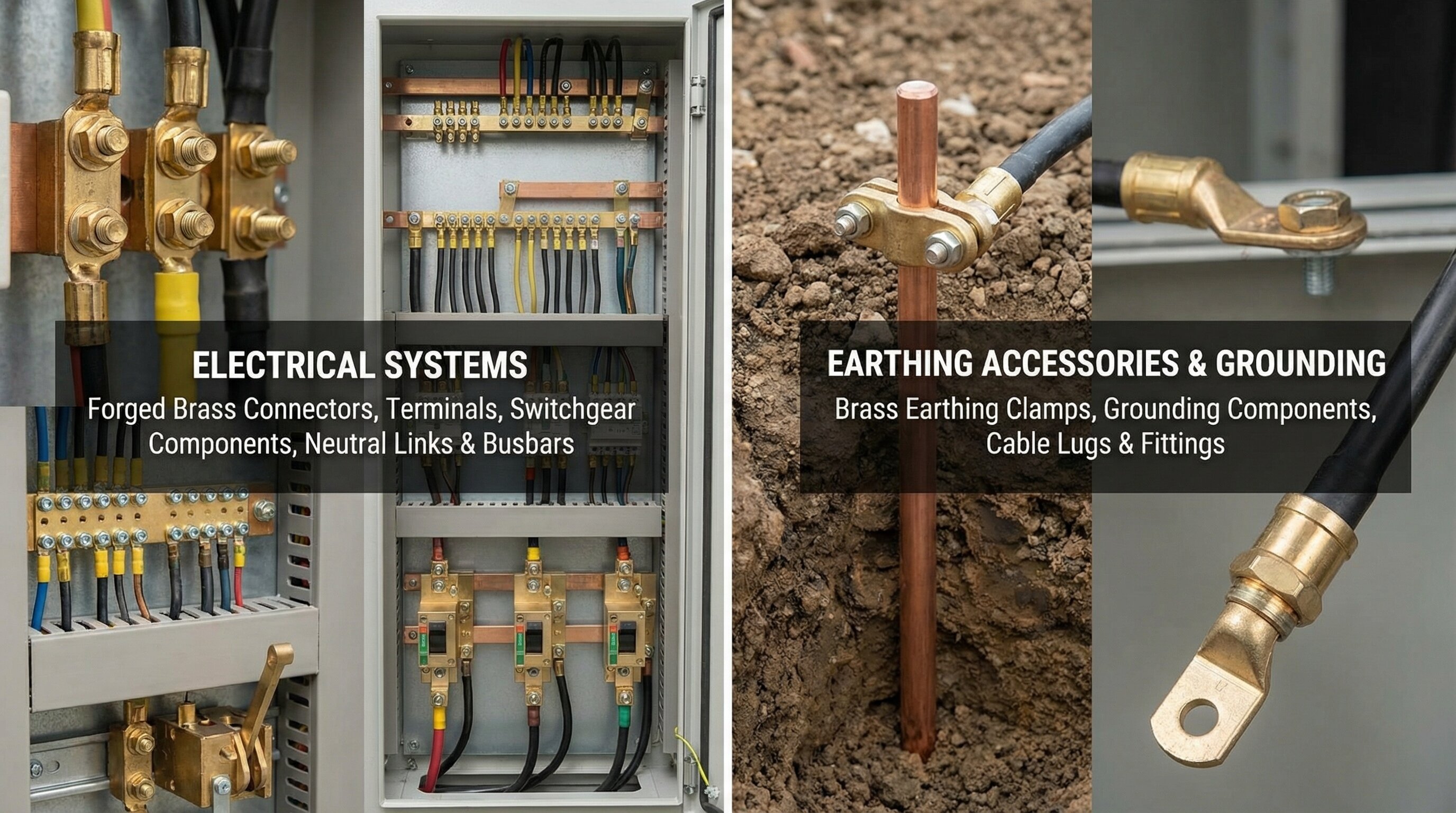
The reliability of any electrical circuit is dependent on the quality of its connections. Forged brass connectors and brass electrical terminals are employed to provide a secure, low-resistance interface between conductors. Because forging allows for high dimensional precision, these terminals are manufactured to ensure maximum surface contact, thereby minimizing voltage drops and preventing overheating at connection points.
2. Brass Switchgear Components
In high-voltage environments, switchgear is used to control, protect, and isolate electrical equipment. Brass switchgear components, such as contact blocks and levers, are preferred because they can withstand the mechanical impact of frequent switching operations. The increased tensile strength provided by forging ensures that these parts do not fracture or fatigue prematurely during the lifespan of the equipment.
3. Brass Neutral Links and Busbars
Current distribution within a panel board is often managed by brass neutral links. These components serve as the central termination point for neutral wires. By using forged brass, a high degree of corrosion resistance is maintained, ensuring that the neutral path remains secure even in humid or chemically aggressive industrial environments.
Essential Brass Earthing Accessories and Grounding Systems
Earthing systems are designed to protect personnel and equipment by providing a safe path for fault currents to dissipate into the ground. The effectiveness of a grounding system is largely determined by the quality of the brass earthing accessories used to bond the conductors.
Brass Earthing Clamps and Grounding Components
To ensure a permanent and reliable connection between the earthing conductor and the ground rod, brass earthing clamps are utilized. These brass grounding components are subjected to harsh soil conditions, where moisture and minerals can lead to rapid oxidation. It is scientifically proven that the dense molecular structure of forged brass provides an effective barrier against such corrosion, maintaining low impedance in the grounding path for decades.
Brass Cable Lugs and Fittings
The termination of heavy-duty grounding cables is achieved through brass cable lugs. These brass electrical fittings are often forged to provide the necessary thickness and strength required for high-torque bolting. Unlike stamped or cast alternatives, forged lugs are less likely to crack when crimped or tightened, ensuring that the electrical bond remains vibration-proof.
Forging vs. Casting for Electrical Accessories
When selecting components for industrial brass forging applications, the differences between forging and casting must be carefully analyzed. The following table outlines the technical advantages of choosing forged parts for electrical and grounding needs.
| Feature | Forged Brass Components | Cast Brass Components |
|---|---|---|
| Grain Structure | Dense, aligned, and continuous | Random, often porous |
| Electrical Conductivity | Optimized due to high density | Variable (affected by internal voids) |
| Mechanical Strength | Superior tensile and impact strength | Lower; prone to brittle failure |
| Corrosion Resistance | Extremely high (no surface pits) | Moderate (pores can trap moisture) |
| Dimensional Accuracy | High precision with minimal finish | Requires extensive secondary machining |
| Durability | Long-term reliability in harsh zones | Prone to stress-corrosion cracking |
The Benefits of Corrosion-Resistant Brass Components
In both indoor and outdoor electrical installations, environmental factors pose a constant threat to system longevity. Corrosion-resistant brass components offer a distinct advantage over ferrous metals like steel or iron. Because brass naturally forms a protective oxide layer, it is shielded from the atmospheric corrosion that leads to rust and electrical failure.
In the context of brass grounding system components, this resistance is vital. Grounding systems are often buried or exposed to the elements; a failure in a single clamp due to corrosion could render the entire safety system useless. Therefore, the use of forged brass is considered an industry best practice for maintaining the integrity of lightning protection and earthing networks.
Technical Specifications: Choosing the Right Alloy
The performance of brass earthing accessories , is also influenced by the specific alloy grade used during the forging process.
- C37700 (Forging Brass): This is the industry standard for hot forging. It offers excellent machinability and superior flow characteristics, making it ideal for complex brass electrical fittings.
- C36000 (Free Cutting Brass): While often used for machining, it is sometimes integrated into forged assemblies where high-speed secondary drilling or threading is required.
By selecting the appropriate metallurgical profile, manufacturers ensure that the finished product meets international standards such as BS, DIN, and ASTM, which are frequently cited in global electrical contracts.
Expert Tip
When installing brass grounding system components, it is recommended that high-quality brass bolts and nuts are also used. Using dissimilar metals can trigger galvanic corrosion, which may eventually increase the resistance of the earthing path and compromise safety.
Frequently Asked Questions (FAQ)
1. Why is forging preferred over casting for brass electrical connectors?
Forging is preferred because it eliminates internal porosity. In electrical applications, any internal void can cause localized heating or "hot spots." The dense structure of a forged part ensures uniform electrical conductivity and greater mechanical strength.
2. Are brass earthing accessories suitable for saltwater environments?
Yes, brass is highly resistant to saltwater corrosion. For marine or coastal applications, forged brass components are often the primary choice for earthing and electrical housing due to their ability to resist dezincification and pitting.
3. Do brass forged components require special maintenance?
Typically, very little maintenance is required. Because the forging process creates a smooth, dense surface, there are fewer places for contaminants to accumulate. However, periodic inspections of connection torques in high-vibration environments are always advised.
4. Can forged brass parts be used in high-voltage switchgear?
Absolutely. Brass switchgear components are designed specifically to handle the thermal and mechanical stresses associated with high-voltage arcs and mechanical actuation, providing a much higher safety margin than cast parts.
5. How does the conductivity of brass compare to copper in forging?
While pure copper has higher conductivity, brass is often chosen for accessories because it is significantly stronger and easier to forge into complex shapes. For most earthing and terminal applications, the conductivity of brass is more than sufficient, while its superior durability provides a longer service life.
6. Is the use of forged brass in electrical systems sustainable?
Brass is a highly sustainable material as it is 100% recyclable without losing its chemical or physical properties. The forging process also produces "near-net-shape" parts, which significantly reduces material waste during manufacturing.
Secure Your Electrical Infrastructure with IQS Engineering Solutions
The integrity of an electrical system is only as strong as its weakest connection. At IQS Engineering Solutions, the production of Brass Forged Components is executed with a focus on metallurgical precision and industrial reliability. Whether the project requires high-volume forged brass connectors for consumer electronics or robust brass earthing accessories for industrial grounding, every component is manufactured to exceed rigorous safety standards.
Are you looking to enhance the conductivity and durability of your electrical installations? Contact IQS Engineering Solutions today to discuss your requirements for brass parts for the electrical industry. Our expertise in industrial brass forging applications ensures that your systems remain safe, efficient, and corrosion-free for years to come. Explore our full range of high conductivity brass parts and see how our precision forging process can optimize your next project.