
Sales Inquiry

How Hot Forged Brass Ball Valve Bodies Prevent Subsurface Porosity vs Castings

October 27, 2026
Hot forged brass ball valve bodies eliminate subsurface gas and shrinkage porosity by utilizing compressive recrystallization above 700°C, compressing dendritic cast structures into dense, continuous grain flow profiles that withstand cyclic fluid pressures exceeding 40 bar. In critical automotive cooling circuits and HVAC hydronic loops, closed-die hot forging reduces helium leak rates to < 1*10{-6} { mbar} 1/s, eliminating through-wall seepage, premature fatigue fractures, and unpredictable field assembly failures.
Key Takeaways for Industrial Stakeholders
- For CFOs & Procurement Leads: Switching from gravity-cast to closed-die forged brass ball valve bodies reduces end-of-line leak test rejection rates from an industry average of 4.2% to < 0.05%, mitigating warranty reserve liabilities and cutting Total Cost of Ownership (TCO) across multi-year vehicle and HVAC production platforms.
- For Chief Engineers & Plant Heads: Closed-die forging aligns the metallurgical grain boundary structure along principal hydrodynamic stress axes, increasing burst pressure limits by up to 35% and preserving internal geometric stability under thermal cycling between -40°C and 150°C.
Critical Engineering Comparison: Cast vs. IQS Precision Forged Valve Bodies
| Technical Parameter / Metric | Commodity Sand / Die-Cast Brass Valve Bodies | IQS Engineering Precision Forged Solutions | Financial & Operational Impact |
|---|---|---|---|
| Internal Structural Density | High risk of volumetric shrinkage voids, entrapped air pockets, and micro-porosity (pore diameters up to 250 mu. | 100% solid, fully compressed, void-free matrix through high-tonnage multi-axial closed-die forging. | Eradicates intermittent hydrostatic failure during commissioning; prevents costly line-stoppage chargebacks. |
| Tensile & Yield Dynamics | Tensile strength: 280–360 MPa; Yield strength: 120–160 MPa. Heterogeneous dendritic grain distribution. | Tensile strength: 440–510 MPa; Yield strength: 200–240 MPa. Optimized longitudinal grain flow contours. | 35% higher structural yield capacity prevents valve body rupture under water hammer and mechanical line vibration. |
| Machined Surface Finish (Ra) | Surface roughness Ra = 1.6–3.2 µm; micro-pits expose subsurface voids during CNC boring. | Surface roughness Ra ≤ 0.4–0.8 µm; uniform metallurgical substrate without pitting. | Extends elastomeric (EPDM/HNBR/PTFE) seal lifespan by 300%; prevents micro-leakage around valve seats and stems. |
| Helium Mass Spectrometry Leak Rates | 10-3 to 1 × 10⁻⁴ mbar·l/s (frequent through-wall micro-fissuring under vacuum/pressure). | < 1 × 10⁻⁶ mbar·l/s verified across 100% of validated production lots. | Meets zero-defect PPM benchmarks for automotive thermal management (EV coolant circuits) and R410A/R32 HVAC systems. |
| Material Traceability & Compliance | Inconsistent batch-level chemistry; broad zinc-loss variances and uncontrolled trace impurities. | Complete lot-specific chemical analysis; certified 3.1 EN 10204 inspection documents and ASTM/EN conformance. | Eliminates compliance audits bottlenecks, material verification delays, and cross-border customs seizures. |
The Physics of Subsurface Porosity: Why Castings Fail Under Fluid Shear
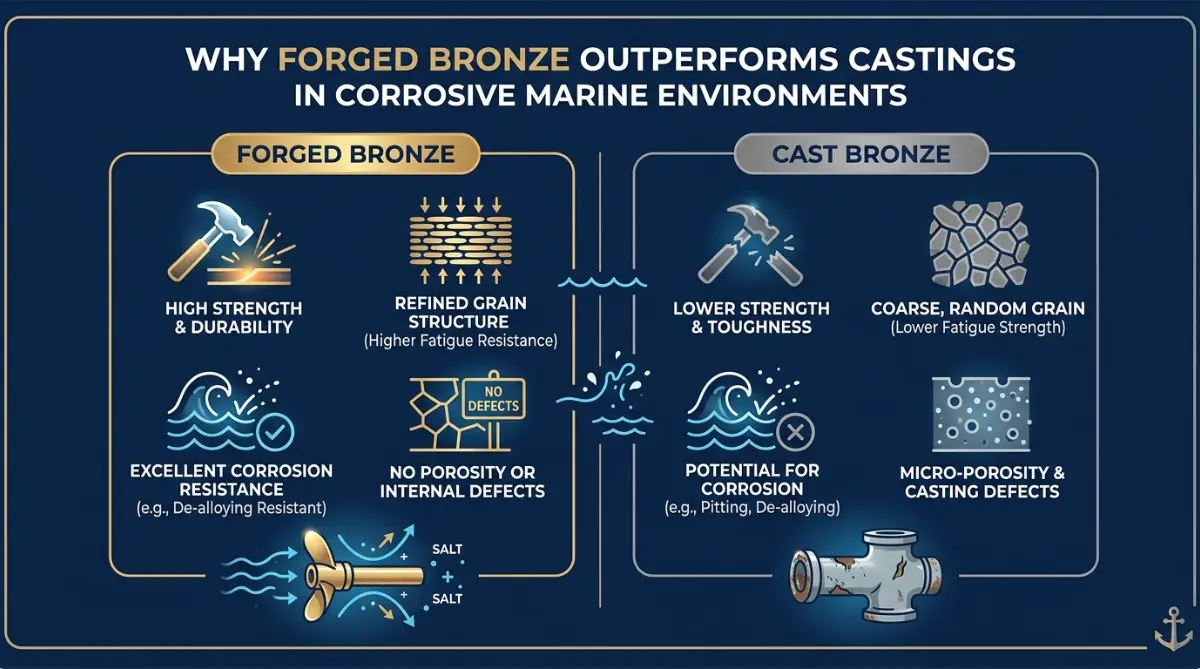
Subsurface porosity in cast brass ball valves occurs during phase transformation from liquid to solid. As molten brass alloys (such as standard CuZn39Pb2 or CuZn40Pb2) cool within a mold cavity, localized volumetric contraction occurs at rates between 3.5% and 5.0%. When casting thick-to-thin transitions—such as the junction between a ball valve's internal seat pocket and its external hexagonal wrench flat—the outer walls solidify first, isolating the thicker interior nodes. This starved liquid volume forms dendritic shrinkage voids. Simultaneously, dissolved gases (primarily hydrogen and atmospheric oxygen entrained during turbulent pouring) precipitate out of solution, forming smooth-walled spherical gas pores that remain trapped below the cast skin.
These cast defects remain latent until precision CNC machining removes the outer unworked crust. Machining valve-seat bores, stem counterbores, and NPT/BSPP threads cuts directly through these internal micro-voids. Under continuous fluid shear in HVAC hydronic pumping systems or high-vibration automotive coolant manifolds, cyclic mechanical stress concentrates at these porous micro-notches. Over operational intervals of 1,500 to 5,000 thermal cycles, fluid penetrates the path of least resistance across interconnected voids, leading to through-wall seepage, fluid contamination, and catastrophic pressure loss.
- Primary Failure Mode 1: Interconnected shrinkage micro-channels venting pressurized refrigerant (R410A, R32, R1234yf) directly to atmosphere through valve bonnet wall sections.
- Primary Failure Mode 2: Cavitation-induced erosion tearing open sub-surface pores positioned along high-velocity valve seat throttling edges.
- Primary Failure Mode 3: Brittle stress-corrosion cracking (SCC) propagating through coarse, unrefined grain boundaries exposed to ammoniacal or chloride-bearing fluid environments.
Closed-Die Hot Forging: Metallurgical Grain Flow and Complete Void Annihilation
Closed-die hot forging replaces thermal phase solidification with mechanical plastic deformation, eradicating internal discontinuities. IQS Engineering processes non-ferrous cylindrical billets by pre-heating them through continuous induction systems to tightly controlled plastic-state temperature windows (typically 680°C to 740°C for alpha-beta dual-phase brasses). The pre-heated billet is transferred to high-tonnage mechanical and screw forging presses, where precision-engineered dies apply compressive forces ranging from 200 to 1,600 metric tons. Under these extreme multi-axial hydrostatic stress states, three distinct metallurgical transformations occur concurrently:
- Mechanical Void Collapse: The localized compressive stress dramatically exceeds the material’s elevated-temperature yield strength, forcing the internal surfaces of any micro-voids or remnant casting pores into intimate contact and pressure-welding them shut.
- Dynamic Recrystallization (DRX): Coarse, heterogeneous as-cast dendritic grains break down into refined, equiaxed grains with average grain sizes transitioning from ASTM No. 3–4 (as-cast) to ASTM No. 7–8 (hot forged).
- Continuous Grain Flow Alignment: Unlike subtractive processes that cut through natural metal fibers, or casting processes that lack directional strength, hot forging forces the crystalline flow lines to sweep continuously around the spherical valve body profile, the thread junctions, and the internal fluid chamber.
This uninterrupted fiber structure redistributes tangential hoop stresses uniformly throughout the valve shell, allowing engineers to design thinner, lighter valve walls that carry significantly higher burst ratings than thicker, porosity-prone sand castings.
Material Grade Integrity: Metallurgical Control in Automotive and HVAC Valves
Engineering fluid control systems requires matching alloy chemistry to specific mechanical, chemical, and regulatory demands. IQS Engineering manufactures hot forged components using strictly validated, non-ferrous alloys compliant with global chemical and physical standards:
1. CW617N / CuZn40Pb2 (EN 12165) / ASTM C37700
- Metallurgical Composition: 57.0–59.0% Cu, 1.6–2.5% Pb, balance Zn, with trace iron and aluminum kept below 0.1% and 0.05% respectively.
- Microstructural Characteristics: The balanced dual-phase (+) matrix ensures exceptional hot deformability in the beta phase at temperatures above 650°C, while preserving high room-temperature mechanical tensile properties and crack arrest from the dispersed alpha phase.
- Target Application: High-pressure ball valve shells for HVAC district heating and closed-circuit industrial fluid loops.
2. CW602N / CuZn36Pb2As (DZR Brass)
- Metallurgical Composition: 35.0–37.0% Zn, 1.7–2.8% Pb, 0.02–0.15% As, balance Cu.
- Microstructural Characteristics: Engineered specifically to inhibit dezincification in aggressive, chlorinated, or slightly acidic soft-water loops. Post-forge proprietary annealing converts susceptible retained beta phases into stable alpha networks passivated by arsenic precipitates.
- Target Application: Automotive auxiliary cooling, engine management thermostat manifolds, and critical maritime plumbing systems.
3. Lead-Free Compliance Alloys (e.g., CW724R / CuZn21Si3P)
- Metallurgical Composition: Silicon-doped copper-zinc matrix featuring < 0.09% Pb content.
- Microstructural Characteristics: Replaces toxic elemental lead lubricants with sub-micron silicon-phosphorus intermetallic phases without inducing hot-short cracking during forging press cycles.
- Target Application: Drinking water potable systems complying with EU Drinking Water Directives and NSF/ANSI/CAN 61 standards.
Dimensional Tolerancing, GD&T, and In-Process CMM Validation
Eliminating structural porosity is half the battle; ensuring the structural geometry meets rigid downstream CNC multi-axis milling and turning requirements is what maintains high-speed assembly line continuity.
Castings naturally exhibit broad dimensional variation due to sand erosion, core shifts, and thermal contraction inconsistencies across disparate mold batches. Closed-die forging, coupled with high-precision in-house tool and die design, guarantees absolute repeatable consistency.
Geometric Dimensioning and Tolerancing (GD&T) Baselines
- Concentricity and Runout: Valve seat cavities, internal sealing tapers, and stem guide journals are machined to true position tolerances within Ø 0.025 mm relative to primary datum dataspaces, preventing premature PTFE packing degradation.
- Thread Axial Alignment: External and internal NPT/BSPP threads maintain pitch diameter runout to within 0.035 mm, ensuring leak-free metal-to-metal torque engagement on automated factory assembly arms.
- Surface Topography (Ra / Rz): Valve internal sealing surfaces achieve Ra ≤ 0.4 µm (16 µin) without secondary hand-polishing operations, eliminating microscopic leak paths around elastomeric seals.
High-Integrity Quality Verification Workflow
Every production run at IQS Engineering follows strict PPAP Level 3 documentation standards:
- Optical Emission Spectrometer (OES) Analysis: Chemical melt tracking verifying alloy composition across each raw material heat number prior to billet cutting.
- Multi-Sensor Coordinate Measuring Machines (CMM): Continuous in-line dimensional checks tracking true position, perpendicularity, and parallelism across batch runs.
- Helium Mass Spectrometer Sniffer Testing: Trace gas detection validating absolute hermetic containment to 1 × 10⁻⁶ mbar·l/s under positive vacuum pressures.
- Hydrostatic Destructive Burst Testing: Batch verification pushing forged valve bodies up to four times their nominal working pressure limit (exceeding 100 bar) to confirm the integrity of localized yield boundaries under extreme operational transients.
Total Cost of Ownership (TCO): The Economic Reality of Forging vs. Casting
While gravity or low-pressure die-casting tooling may appear attractive from an initial piece-price perspective, procurement teams calculating comprehensive Total Cost of Ownership recognize that casting porosity introduces substantial hidden processing costs.
1. Zero Requirement for Secondary Vacuum Resin Impregnation
Cast valve manufacturers often apply secondary anaerobic resin impregnation to salvage porous, leaky castings. This process adds \.35\0.80 per unit in processing costs and introduces long-term failure risks: high-temperature coolant loops and harsh refrigerants can dissolve or degrade these polymer sealants over time, causing delayed leaks in the field. Closed-die forged brass requires zero chemical impregnation.
2. CNC Machining Tool Life and Cycle Time Improvements
Castings contain hard inclusions—such as refractory sand remnants, aluminum oxides, and hard silicon phases—that chip carbide tooling inserts during internal boring operations. These inclusions induce micro-chatter, degrade surface finishes, and cause unexpected tool breakage. Chemically uniform forged brass permits continuous, high-speed multi-axis CNC machining, improving cycle times by 22% and extending insert tool life by up to 300%.
3. Assembly Scrap Reductions and Field Warranty Protection
Discovering a porous component during incoming quality control costs pennies. Discovering a through-wall micro-leak during final hydrostatic testing of a fully assembled automotive engine cooling subsystem or HVAC heat pump chiller costs hundreds of dollars in teardown labor. Discovering a through-wall leak post-sale in an automotive heating loop creates catastrophic warranty liabilities. IQS Engineering’s forged valve bodies eliminate porosity at the molecular level, delivering a reliable, zero-defect foundation for critical assemblies.
Optimize Your Fluid System Integrity with IQS Engineering
Eliminating subsurface porosity requires strict control over thermodynamic heating parameters, die geometry kinematics, compressive tonnage dynamics, and metallurgical verification. IQS Engineering operates a vertically integrated manufacturing infrastructure—from in-house tool design and precision die sinking to high-tonnage closed-die forging presses and automated multi-axis CNC machining centers.
Whether you are engineering next-generation electric vehicle thermal battery cooling circuits, high-pressure HVAC hydronic mixing valves, or mission-critical industrial fluid handling lines, our technical engineering team provides comprehensive Design for Manufacturability (DFM) reviews to transition your porous castings into high-strength, void-free forgings.
Accelerate your development cycle and mitigate supply chain vulnerability. Submit your 2D/3D CAD technical drawings (.STEP, .IGES, .DWG) to the IQS Engineering technical team today for a comprehensive metallurgical review, tooling feasibility breakdown, and formal commercial quotation.
Frequently Asked Questions
1. Why are cast brass valve bodies more vulnerable to subsurface porosity than forged bodies?
Cast brass components rely on gravity or low pressure to fill mold cavities, inherently undergoing liquid-to-solid volumetric shrinkage between 3.5% and 5%. This contraction creates starved dendritic voids in thicker cross-sections. In addition, turbulent pouring traps ambient gases (hydrogen and oxygen) within the melt, resulting in subsurface micro-porosity. Hot forging avoids this phase change entirely by heating solid billets into their plastic recrystallization range (680°C–740°C) and compressing them under hydraulic or mechanical loads exceeding hundreds of tons. This high hydrostatic pressure collapses any pre-existing structural voids and pressure-welds the crystalline matrix into a 100% dense structure.
2. What specific helium leak rates can be reliably achieved with hot forged brass ball valves?
IQS Engineering hot-forged brass valve bodies consistently achieve hermetic leak tightness ratings of < 1*10^{-6}\text{ mbar}\cdot\text{l/s}$ verified under vacuum mass spectrometry testing. By comparison, cast brass valve bodies typically report leak rates ranging from $1 \times 10^{-3}\text{ to }1*10^{-4}\text{ mbar}\cdot\text{l/s}$ due to interlinked micro-porosity pathways across machined wall sections. This orders-of-magnitude performance improvement makes hot forged brass suitable for high-risk, volatile fluid circuits, including R32 and R410A refrigerants, hazardous chemical manifolds, and pressurized automotive EV cooling loops.
3. How does the grain flow pattern of a forged brass valve body improve mechanical burst pressure?
In a casting, the grain structure is non-directional, dendritic, and brittle along inter-granular boundaries. During closed-die hot forging, plastic deformation forces the metallic crystal matrix to re-orient along the continuous geometric contours of the tooling impression. This creates uninterrupted longitudinal grain flow lines wrapping smoothly around the valve cavity, port transitions, and hex junctions. Because mechanical loads, cyclic pressure spikes, and water-hammer stresses are distributed parallel to these consolidated grain fibers rather than across them, forged bodies achieve up to 35% higher mechanical burst pressure resistance than cast bodies of equivalent wall thickness.
4. Can forged brass valves withstand aggressive automotive glycol coolants and low-viscosity HVAC fluids?
Yes. By utilizing specialized single-phase or stabilized dual-phase alloys such as CW602N (CuZn36Pb2As) or silicon-doped brasses, forged valves provide superior resistance to dezincification (DZR) and stress corrosion cracking (SCC). Cast brass alloys frequently segregate zinc-rich beta phases along dendritic branches during uncontrolled mold cooling, creating rapid chemical corrosion paths when exposed to automotive ethylene/propylene glycol coolants. The dynamic recrystallization achieved during hot forging disperses alloying additions (such as arsenic inhibitors) uniformly across refined grain boundaries, eliminating zinc-leaching pathways.
5. What are the economic trade-offs when transitioning from cast brass to hot forged brass ball valves?
While cast brass components may carry slightly lower initial tooling and piece-price estimates, they impose significant downstream operational costs: high scrap rates post-CNC machining (often 3% to 7% due to uncovered porosity), expensive tooling downtime caused by abrasive casting inclusions, and the recurring cost of secondary resin impregnation (0.35–0.80 per piece). In contrast, hot forged components provide near-net-shape consistency, 22% faster CNC cycle times, up to 300% longer cutting-tool life, zero need for impregnation, and near-zero scrap rates (< 0.05\%), yielding a lower overall Total Cost of Ownership (TCO).