
Sales Inquiry

Why Forged Bronze Components Outperform Castings in Corrosive Marine Environments

September 26, 2026
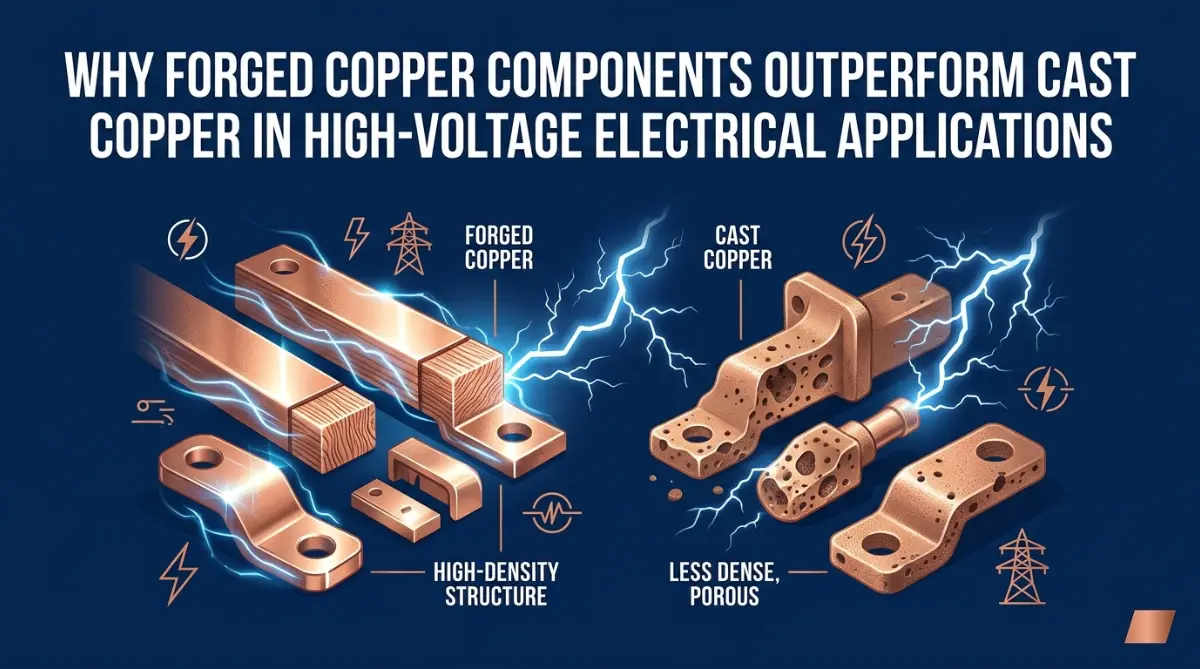
Forged bronze components eliminate the internal porosity, shrink voids, and dendritic grain boundaries inherent to cast bronze, delivering up to a 40% increase in fatigue strength and superior resistance to micro-galvanic dealloying in high-salinity marine environments. For critical marine valve systems and subsea pipeline hardware operating under continuous cyclic pressures above 25 bar, forged copper-base alloys prevent subsurface crevice propagation and structural shear failures common in lower-density sand and investment castings.
Key Takeaways for Industrial Stakeholders
- For CFOs & Sourcing Managers: Forged bronze reduces Total Cost of Ownership (TCO) by virtually eliminating pre-commissioning pressure test rejections and unscheduled drydock repairs caused by subsurface structural porosity defects.
- For Chief Engineers & Quality Leads: Forged bronze yields closed-die grain alignment that raises yield strength above 320 MPa, maintains surface finish roughness ($Ra$) below $0.8\,\mu\text{m}$, and eliminates interstitial fluid entrapment under high axial shear loads.
Marine Hardware & Valve Performance Comparison
| Technical Parameter / Metric | Commodity Sand / Investment Castings | IQS Precision Forged Bronze Solutions | Financial & Operational Impact |
|---|---|---|---|
| Grain Microstructure & Density | Random dendritic grains with shrinkage voids and gas porosity | Refined, directional flow lines with zero internal voids | Eliminates pressurized fluid seepage; prevents structural fatigue cracking |
| Tensile & Yield Strength (C95800 Nickel Aluminum Bronze) | Yield: ~240–270 MPa Tensile: ~580–620 MPa |
Yield: ≥340–380 MPa Tensile: ≥680–740 MPa |
Allows 15–20% thinner wall profiles without sacrificing burst pressure ratings |
| Dealloying & Corrosion Resistance | Susceptible to localized dealuminization in interdendritic zones | Homogeneous phase distribution resists plug-type dealloying | Extends operational maintenance intervals in subsea manifold valves from 3 to 10+ years |
| Machined Surface Roughness (Ra) | $1.6\,\mu\text{m}$ to $3.2\,\mu\text{m}$ (pitting/voids expose fresh metal) | $<0.4\,\mu\text{m}$ to $0.8\,\mu\text{m}$ across sealing interfaces | Minimizes elastomeric seal wear, preventing valve stem leakage |
| Material Certification Compliance | Standard ASTM B148 / EN 1982 | EN 10204 Type 3.1/3.2 with full NDT traceable heat treatment | Guarantees compliance for DNV, Lloyd’s Register, and ABS marine audits |
Metallurgical Mechanics: Microstructure and Grain Alignment
The structural degradation of marine valves and pipeline fittings under continuous exposure to seawater is primarily dictated by internal grain architecture.Cast bronze components form randomly oriented dendritic networks as molten metal solidifies within a mold. This non-uniform cooling generates microscopic shrinkage cavities, gas pockets, and interdendritic segregation phases. Under seawater immersion, these voids trap stagnant fluid containing high
concentrations of chloride ions (Cl-), creating local micro-galvanic cells that accelerate dealuminization and dezincification beneath the surface.
Forging alters this fundamental mechanical behavior through controlled plastic deformation above the recrystallization temperature. Closed-die precision forging compresses the alloy, crushing internal voids and refining coarse dendritic structures into continuous grain flow lines that align with the component's primary stress vectors.
Key Metallurgical Characteristics of Forged Marine Bronze
- Elimination of Interdendritic Segregations: Thermomechanical processing homogenizes the copper-aluminum-nickel phase balance (+ phases in Nickel Aluminum Bronze), removing localized low-copper regions vulnerable to galvanic attack.
- Continuous Directional Grain Boundary Flow: Grain lines wrap around geometric features such as valve seats, flange necks, and threaded ports, resisting shear plane displacement under high pressure spikes.
- Controlled Phase Transformations: Post-forge heat treatment profiles (cooling at rates exceeding 30C/min followed by tempering at 650C) prevent the formation of continuous, brittle 2 phase networks.
Mechanical Integrity Under High-Pressure Marine Loading
Subsea manifolds, hull valves, and ballast piping systems operate under continuous hydrodynamic loading, thermal fluctuations, and pressure surges (water hammer). Mechanical failure in these systems typically manifests as fatigue fracturing along internal casting imperfections or crevice corrosion beneath valve stem packing.
By specifying contract CNC-machined forged bronze stock, chief engineers eliminate hidden internal flaws that bypass standard surface dye-penetrant testing. When subjected to Geometric Dimensioning and Tolerancing (GD&T) verifications—such as tight runout (0.012mm) and perpendicularity checks—forged stock maintains dimensional stability without structural relaxation during heavy roughing passes.
Critical Quality Checklist for Marine Valve & Pipe Procurement
- Ultrasonic Testing (UT) Verification: Ensure zero internal attenuation anomalies exceeding 1.5mm equivalent flat-bottom hole criteria per ASTM A388/EN 10228.
- Surface Roughness Limits: Specify $R_a \le 0.4\,\mu\text{m}$ on sealing surfaces to prevent micro-fretting against elastomeric valve packing rings.
- Chemical Traceability: Require full EN 10204 3.1 chemical analysis certifying aluminum content between $8.5\%$ and $10.5\%$ and nickel content above $4.0\%$ (for C95800/CU3 grades) to prevent selective leaching.
- Hardness Testing: Verify minimum Brinell Hardness (HBW 10/3000) of 160–200 across the entire cross-section to resist cavitation erosion in high-velocity seawater flow areas (>3.5m/s).
Total Cost of Ownership (TCO) & Supply Chain Dynamics
While raw forged bronze billets carry an initial material premium over standard green sand castings, evaluating procurement costs purely on upfront weight pricing leads to significant long-term financial risk.
- Machining Scrap Reductions: Subsurface air pockets in cast valve bodies are often uncovered only during final precision finish-turning or tapping operations. Uncovering porosity at the final stage leads to scrapped machining hours, tool bit damage, and production delays. Forged blanks guarantee uniform material density, eliminating late-stage scrap.
- Elimination of Leak-Test Failures: Marine pipeline manifolds are subject to hydrostatic pressure testing at 1.5 design pressure prior to installation. Cast components frequently fail hydro-tests due to micro-porosity wall seepage, forcing costly impregnation treatments or total part replacement.
- Downtime Mitigation in Marine Infrastructure: Replacing a failed hull-penetration valve or subsea connector requires emergency drydocking or offshore support vessel intervention. The operational cost of off-hire time far outweighs the initial manufacturing cost of the engineered component.
When sourcing components through specialized precision engineering partners like IQS Engineering Services, procurement managers secure stable, certified component flows optimized for both high-tolerance machining and long-term marine service.
Secure High-Precision Forged Marine Components Today
Avoid the structural and financial risks of casting porosity in your critical marine infrastructure. Whether you require contract CNC machining for custom valve stems, high-tolerance forged bronze flanges, or custom subsea pipeline components, IQS Engineering provides fully certified, zero-defect marine manufacturing solutions built to strict ISO 9001 and marine class standards. Submit your engineering drawings and material specifications today for an immediate technical review and competitive RFQ analysis.
Frequently Asked Questions
1. Why is forged bronze less susceptible to dealuminization than cast bronze?
Dealuminization occurs when stagnant seawater attacks continuous, aluminum-rich phases (2 phase) along dendritic grain boundaries found in cast structures. Forging breaks up these continuous dendritic networks and, combined with proper heat treatment, creates a refined, homogeneous grain distribution with discrete phase precipitates, suppressing selective leaching pathways.
2. Can forged nickel aluminum bronze (NAB) be used for direct seawater subsea applications?
Yes, forged nickel aluminum bronze (such as UNS C95800 / Copper Alloy C63200) is widely specified for subsea applications. The addition of nickel and iron enhances cavitation resistance, stress corrosion cracking resistance, and mechanical yield strength under cyclic marine pressure.
3.How does forging improve the sealing performance of marine ball and globe valves?
Forging eliminates internal voids and gas pockets, allowing CNC operators to machine sealing faces to ultra-smooth surface finishes ($R_a < 0.4\,\mu\text{m}$) without exposing subsurface pits. This uniform density ensures long-term gasket and seat contact without micro-leak paths forming across the flange or seat interfaces.
4.What material certificates should be specified for forged marine pipeline hardware?
Marine pipeline hardware should be specified with EN 10204 Type 3.1 or Type 3.2 material certificates. These ensure full chemical traceability, mechanical batch testing (tensile, yield, impact), non-destructive testing (NDT) reports, and verification of proper solution annealing/tempering heat treatments.
5.Is forged bronze compatible with high-velocity seawater flow systems?
Forged nickel aluminum bronze offers exceptional resistance to impinging flow and cavitation erosion, maintaining structural integrity at flow velocities exceeding 4.5m/s. Cast bronzes are typically capped at lower velocities due to the risk of accelerated erosion at surface void sites.