
Sales Inquiry

Open vs Closed Die Forging: Applications, Advantages & Differences

May 12, 2026
Open vs Closed Die Forging: Applications, Advantages & Differences
Open vs Closed Die Forging represents the two primary methodologies used in the metal deformation industry to produce high-strength, structural components. While open die forging involves the shaping of heated metal parts between multiple dies that do not completely enclose the material, closed die forging (also known as impression die forging) utilizes precision-machined dies to encapsulate the workpiece, forcing it into a specific, predetermined shape.
Understanding Industrial Forging Techniques
Forging is recognized as one of the oldest and most reliable manufacturing processes, utilized to enhance the mechanical properties of metals through controlled deformation. In modern engineering, the selection between forging methods is dictated by the required part complexity, production volume, and the final application's structural demands.
The Open Die Forging Process
Open die forging, often referred to as smith forging, is characterized by the use of flat or simple-shaped dies. In this process, the metal workpiece is not laterally confined. The material is compressed by a hammer or press, and the operator or a manipulator rotates the piece to achieve the desired dimensions.
Deformation Control: The metal is worked above its recrystallization temperature, ensuring that the internal grain structure is refined.
Size Versatility: Components weighing from a few kilograms to hundreds of tons can be accommodated.
Tooling Simplicity: Because the dies are often flat or have simple contours, tooling costs are significantly lower than alternative methods.
Advantages of Open Die Forging
Enhanced Structural Integrity: Voids are eliminated through consistent pressure, and the grain flow is aligned to increase the fatigue resistance of the part.
Reduced Lead Times: Since custom, complex dies are not required for most shapes, production can often begin immediately.
Material Economy: For large, simple shapes like cylinders, shafts, and rings, material waste is kept to a minimum.
Open Die Forging Applications
This method is predominantly utilized for the production of large-scale components where strength is paramount.
Shafts and Rotors: Used in power generation and marine propulsion.
Seamless Rolled Rings: Essential for heavy machinery and aerospace bearings.
Hollows and Shells: Critical for pressure vessels and oilfield equipment.
The Closed Die Forging Process
Closed die forging process involves the use of two or more dies containing a precut profile of the desired part. The heated metal is placed in the bottom die, and the top die is brought down with immense force, causing the metal to flow into every cavity of the die.
Impression Precision: High-tolerance parts with complex geometries are achievable.
Flash Formation: Excess material, known as "flash," is forced into a gutter and later trimmed away.
High Volume Efficiency: Once the dies are manufactured, parts can be produced at a very high rate with excellent consistency.
Advantages of Closed Die Forging
Complex Geometries: Intricate shapes that would be impossible or prohibitively expensive to machine are easily produced.
Superior Surface Finish: The containment of the metal within the die results in a smoother finish and better dimensional accuracy compared to open die methods.
Net Shape Capability: Many parts are produced to "near-net shape," meaning minimal secondary machining is required, saving time and costs in the long run.
Closed Die Forging Applications
Due to the high cost of tooling, this method is typically reserved for high-volume production in critical sectors.
Automotive Components: Connecting rods, crankshafts, and gears.
Aerospace Hardware: Turbine disks, bulkheads, and landing gear components.
Defense and Tools: Firearm components and high-grade hand tools (wrenches and pliers).
Forging Methods Comparison: A Technical Breakdown
For procurement teams and engineers, the choice between these methods is often a balance of volume, cost, and complexity. The following table summarizes the primary differences:
| Feature | Open Die Forging | Closed Die Forging |
|---|---|---|
| Die Shape | Flat or simple shapes (V-shape, round) | Complex, custom-machined impressions |
| Part Complexity | Simple (shafts, rings, disks) | High (gears, connecting rods) |
| Material Enclosure | Not enclosed; metal flows laterally | Fully enclosed; metal follows die contours |
| Production Volume | Low to medium | High (mass production) |
| Tooling Cost | Low | High (expensive die manufacturing) |
| Machining Required | Significant post-forging machining | Minimal (near-net shape) |
| Part Weight | Up to 200+ tons | Generally under 250 kg |
Metallurgical Superiority: Why Forging Trumps Casting
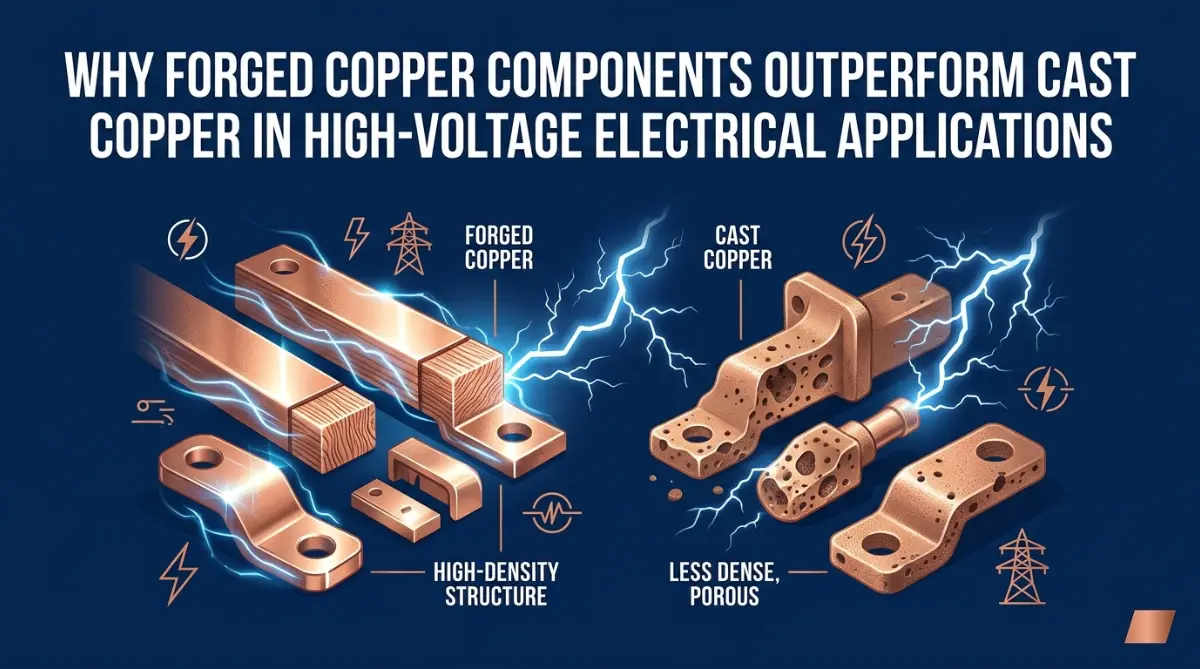
Scientific studies and industrial tradition demonstrate that forged components provide higher yield strength and greater ductility than cast or machined parts. During the forging process, the metal's internal grain structure is manipulated to follow the shape of the part.
Higher Impact Strength: The ability to withstand sudden loads without failure.
Directional Toughness: Strength is concentrated in the areas where it is most needed by the application.
Reliability: Internal flaws and porosity common in casting are eliminated, ensuring a higher level of safety for critical components.
Frequently Asked Questions (FAQ)
1. Which is stronger: open die or closed die forging?
Both processes provide exceptional strength through grain refinement. However, closed die forging allows for more precise control over grain flow in complex shapes, potentially offering superior strength in multi-directional stress applications.
2. Why is closed die forging more expensive for small orders?
The high cost is attributed to the creation of custom dies. These dies must be precision-machined from high-strength tool steel and heat-treated, a process that can cost thousands of dollars before a single part is produced.
3. Can all metals be forged using both methods?
Most metals, including carbon steel, alloy steel, stainless steel, aluminum, and titanium, are suitable for both methods. The choice is usually governed by the part’s geometry and volume rather than the material type.
4. What is 'Flash' in the closed die forging process?
Flash is the excess metal that is forced out of the die cavity into a specialized gutter. It serves a functional purpose by ensuring the die is completely filled and is later removed through a trimming process.
5. How does forging improve safety in heavy industry?
Forging eliminates internal voids and gas pockets that can lead to catastrophic failure. In industries like aerospace and oil and gas, forged parts are mandated for high-pressure or high-load environments to ensure maximum safety.
Partner with IQS Engineering for High-Performance Forgings
Superior engineering demands components that can withstand extreme conditions without compromise. At IQS Engineering, excellence in metal deformation is achieved through rigorous quality control and technical expertise. Whether your project requires the massive scale of open die forging or the precision of closed die solutions, specialized support is available to optimize your supply chain.