
Sales Inquiry

Applications of Aluminium Forging Products in Medical Supplies

June 17, 2026
Key Takeaways
- Aluminium forging produces stronger, denser, and more reliable medical components than casting because the forging process refines the metal's grain structure under pressure.
- Forged aluminium parts show up in surgical instruments, mobility aids, diagnostic imaging equipment, sterilization tools, and medical gas systems.
- Alloys like 6061, 6082, and 7075 are chosen based on whether a part needs more strength, more corrosion resistance, or better machinability.
- Aluminium's natural resistance to corrosion and its non-magnetic properties make it a safe, long-lasting choice for environments where hygiene and sterilization matter.
- As demand for lightweight, durable medical equipment keeps climbing into 2026, manufacturers are leaning harder on forged aluminium components for both cost and performance reasons.
If you've ever wondered why your doctor's wheelchair feels lighter than your grandfather's old steel one, or why an MRI machine doesn't go haywire near a smartphone, the answer often comes down to one quiet workhorse: forged aluminium. Aluminium forging products are used throughout the medical industry to build lightweight, corrosion-resistant, and high-strength components, including surgical instruments, mobility aids, gas cylinders, sterilization equipment, and diagnostic machinery, because forging creates denser, more reliable parts than casting alone.
That's the short version. Now let's get into why this matters, and where you'll actually find these parts in a hospital, clinic, or medical device factory.
Why Hospitals and Device Makers Keep Reaching for Aluminium
Walk through any modern hospital and you're surrounded by aluminium, even if you don't notice it. It's in the wheelchair by the door, the IV pole next to the bed, and the housing of the CT scanner down the hall.
There's a reason for that pattern, and it's not just tradition. Aluminium happens to check almost every box that medical equipment manufacturers care about.
It's light enough to move, but strong enough to trust. A nurse pushing a crash cart all shift, or a patient leaning on a walker, needs something that won't wear them out. Aluminium's strength-to-weight ratio solves that problem better than steel, without sacrificing the durability a hospital environment demands.
It resists corrosion in places where contamination isn't an option. Hospitals run on sterilization. Instruments get autoclaved, scrubbed, and disinfected constantly, and any material that rusts or pits over time becomes a hygiene risk. Aluminium naturally forms a protective oxide layer that keeps it from corroding under that kind of repeated chemical and thermal stress.
It won't mess with sensitive electronics or magnetic fields. This one's huge for diagnostic equipment. MRI machines depend on a stable magnetic environment, and aluminium's non-magnetic, non-sparking nature means it can sit right next to the most sensitive imaging hardware without causing interference.
What Makes Forged Aluminium Different From Cast or Machined Parts
Here's where a lot of people get tripped up. Aluminium is aluminium, right? Not quite. How you shape the metal changes what it can do.
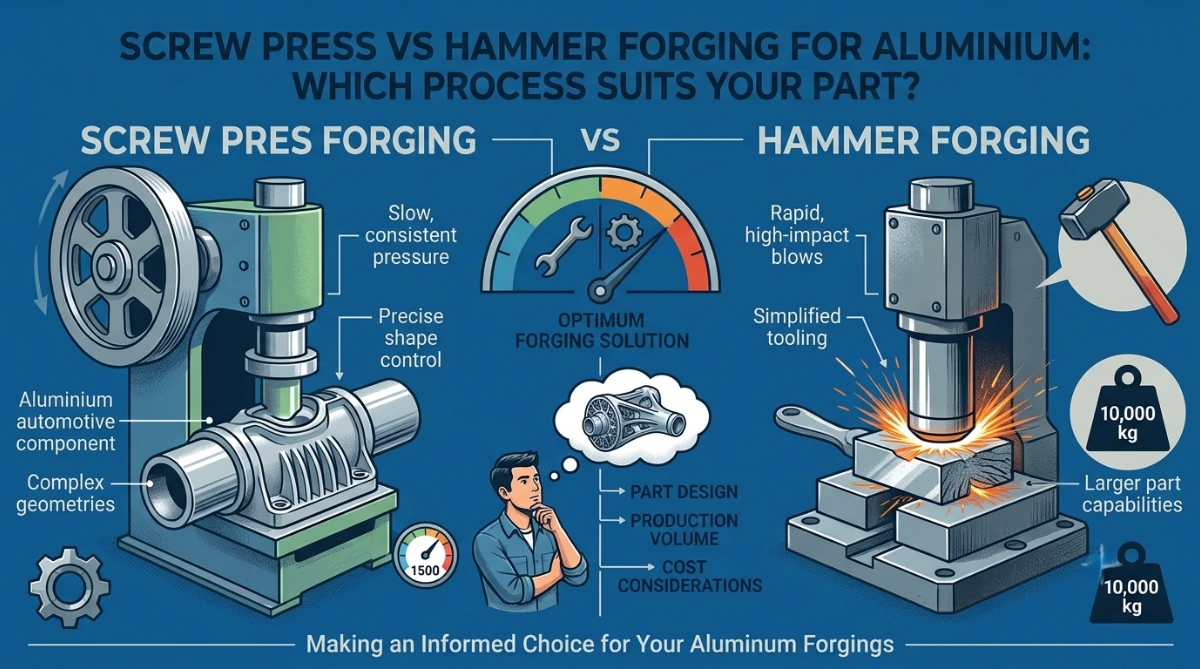
Casting involves pouring molten aluminium into a mold and letting it cool. Forging is different: it involves compressing solid aluminium under intense pressure, using hammers, presses, or dies, to physically reshape the metal's internal grain structure.
That distinction matters more than it sounds like. When you forge a part, you're not just molding a shape, you're aligning the metal's grain flow along the contours of the final piece. The result is a component with:
- Higher tensile strength because the grain structure has no porosity or air pockets, unlike castings
- Better fatigue resistance, which matters enormously for parts that get used and sterilized thousands of times over a device's lifespan
- Excellent surface finish, reducing the risk of bacteria-trapping micro-crevices
- More design flexibility, allowing manufacturers to match the part precisely to a surgeon's or technician's specifications
If you're sourcing components for surgical-grade equipment, this is the kind of detail worth digging into with your supplier. A company offering aluminium forging products built specifically to medical-grade standards and tolerances can usually walk you through which alloy and forging method fits your application best, rather than handing you a generic catalog part.
Where You'll Actually Find Forged Aluminium in Medical Settings
Let's get specific. This isn't abstract material science, it's parts you've probably touched or stood next to without realizing it.
Surgical Instruments
Scalpels, forceps, retractors, and clamps all benefit from a material that's light in the surgeon's hand but rigid enough not to flex mid-procedure. A surgeon doing a four-hour operation needs an instrument that feels the same in hour four as it did in minute one. Forged aluminium components hold their shape and edge far better than cast alternatives, and they shrug off the repeated heat cycles of autoclave sterilization without warping.
Mobility Aids and Patient Support Equipment
Wheelchairs, walkers, crutches, and hospital bed frames lean heavily on forged aluminium for the same reason a cyclist prefers a lighter bike frame: every pound matters when a person has to move it themselves, or when a caregiver has to lift and adjust it dozens of times a day. The forging process gives these frames the load-bearing strength to support different body weights without adding bulk.
Diagnostic Imaging Equipment
MRI and CT machines rely on dozens of structural and housing components that have to stay non-magnetic and thermally stable. A forged aluminium bracket or frame inside that imaging suite isn't going to interfere with the magnetic field or expand unpredictably under the heat the machine generates during long scan sessions. That stability translates directly into image accuracy and equipment longevity.
Medical Gas Cylinders and Pressure Systems
Oxygen tanks and other medical gas containers need to survive high internal pressure, frequent transport, and the occasional drop without failing. Forged aluminium handles pressure loads more predictably than cast metal because there's no internal porosity that could become a weak point under stress. That's not a small detail when the cylinder in question is keeping a patient breathing during an ambulance transfer.
Sterilization Equipment
Autoclaves cycle through extreme heat and steam pressure thousands of times over their working life. Components inside these machines need even thermal distribution so they heat and cool consistently, otherwise you get hot spots that compromise sterilization quality. Forged aluminium parts handle that thermal cycling with far less fatigue than you'd see in cast components doing the same job.
Connecting Rods, Valves, and Pneumatic Fittings
A lot of medical equipment, from ventilators to automated diagnostic carts, relies on precision pneumatic and hydraulic systems. Forged aluminium valves, pins, and connecting rods show up here because they need tight tolerances and consistent performance under repeated mechanical stress, exactly what forging is built to deliver.
Choosing the Right Alloy: 6061, 6082, 7075, and 2014
Not every part needs the same alloy, and this is where a lot of buyers either overspend or underspec their components.
Aluminium 6061 is the generalist of the group. It machines easily, welds reasonably well, and holds up fine for support structures and frames where extreme strength isn't the top priority.
Aluminium 6082 offers a step up in strength while keeping good corrosion resistance, making it a common choice for structural medical equipment components that need to handle moderate stress over a long service life.
Aluminium 7075 is the heavy hitter. Its tensile strength nearly doubles that of 6061 in the T6 temper, which makes it the go-to choice for high-stress applications like surgical-grade instruments or load-bearing mobility equipment, though it does sacrifice a bit of machinability and weldability for that extra muscle.
Aluminium 2014 brings strong machinability and good fatigue resistance, which makes it useful for components that need precise, repeatable manufacturing at scale.
A good rule of thumb for 2026 buyers: if the part touches a patient directly and needs to flex slightly under load (like a mobility aid frame), 6061 or 6082 usually does the job. If the part needs to survive repeated high-stress cycles without deforming, like certain surgical tooling, 7075 earns its higher price tag.
Frequently Asked Questions (People Also Ask)
1. What is aluminium forging used for in medical supplies?
Aluminium forging is used to manufacture surgical instruments, mobility aids, diagnostic imaging components, medical gas cylinders, sterilization equipment, and pneumatic parts for ventilators and automated medical carts. The forging process gives these parts higher strength, better fatigue resistance, and a smoother surface finish than cast or unforged alternatives.
2. Why is aluminium preferred over steel for medical equipment
Aluminium offers a significantly better strength-to-weight ratio than steel, which makes equipment easier for patients and caregivers to handle. It also resists corrosion naturally, doesn't interfere with magnetic imaging equipment, and typically costs less to manufacture and ship due to its lighter weight.
3. Is forged aluminium safe for surgical instruments?
Yes. Forged aluminium components used in medical-grade instruments go through strict alloy selection and surface finishing to meet sterilization and biocompatibility standards. The forging process itself improves surface quality and reduces the micro-crevices where bacteria could otherwise hide, which supports more reliable sterilization outcomes.
4. What's the difference between cast and forged aluminium parts?
Cast aluminium is poured into a mold and cooled, which can leave tiny air pockets or porosity inside the part. Forged aluminium is compressed under high pressure while solid, which aligns the metal's grain structure and eliminates that porosity, resulting in a stronger, more fatigue-resistant component overall.
5. Which aluminium alloy is best for medical devices?
It depends on the application. 6061 and 6082 work well for general structural parts and frames that need a balance of strength and machinability. 7075 is better suited for high-stress components like certain surgical tools or load-bearing mobility equipment, since it offers nearly double the tensile strength of 6061 in its T6 temper.
6. Which aluminium alloy is best for medical devices?
It depends on the application. 6061 and 6082 work well for general structural parts and frames that need a balance of strength and machinability. 7075 is better suited for high-stress components like certain surgical tools or load-bearing mobility equipment, since it offers nearly double the tensile strength of 6061 in its T6 temper.
Final Thoughts
The medical field is only getting faster, smarter, and more advanced.
If you are relying on outdated casting methods or heavy steel components for your medical devices, you are going to fall behind the curve. Forging your aluminum parts doesn't just improve your product's lifespan it directly impacts the safety and quality of patient care.
Take a hard look at your supply chain today. Where can you swap a heavy, cast part for a lighter, forged one?