
Sales Inquiry

Forging, Casting, or CNC Machining? How to Choose the Right Manufacturing Process

July 23, 2026
Every day, product designers, mechanical engineers, and procurement managers face a critical decision: which manufacturing process will deliver the right balance of performance and price? Choosing between forging, casting, and CNC machining isn't just about cost optimization. It dictates your product's mechanical strength, dimensional accuracy, lead time, and long-term reliability in the field.
Make the wrong choice, and you risk premature component failure, excessive material waste, or blown tooling budgets. Make the right choice, and you secure a highly efficient production run with parts that withstand decades of heavy industrial use.
If you are an OEM buyer or a purchase engineer trying to navigate this landscape, this comprehensive guide will break down exactly how forging, casting, and CNC machining compare. We will explore material properties, production volume suitability, and real-world industrial applications so you can source with total confidence.
What is Forging?
Forging is a manufacturing process that shapes solid metal using localized compressive forces. Instead of melting the metal or cutting it away, forging deforms it in a solid (or semi-solid) state, usually after heating it to specific forging temperatures.
From a metallurgical standpoint, forging is unmatched. As the metal is pressed or hammered into shape, its internal grain structure aligns with the contours of the part. This continuous grain flow significantly increases the mechanical strength, fatigue resistance, and impact tolerance of the component.
- Closed Die Forging: Also known as impression-die forging, this method forces hot metal into precision-machined steel dies. It produces near net shape components with excellent dimensional accuracy. It is highly cost-effective for batch production and high volume manufacturing.
- Open Die Forging: Used primarily for massive, simple shapes, the metal is hammered between flat dies that do not completely enclose the material.
Forging is the backbone of industries that cannot tolerate part failure. When you look at load-bearing components like heavy truck axle components, railway couplings, or aerospace brackets, you are almost always looking at a forged part.
What is Metal Casting?
Metal casting involves melting metal into a liquid state and pouring it into a hollow mold cavity. Once the metal cools and solidifies, it takes the shape of the mold. The part is then ejected or broken out for finishing.
Casting is highly versatile and comes in several forms:
- Sand Casting: Uses sand-based molds. It is inexpensive to tool up and great for massive parts, but offers a rougher surface finish.
- Investment Casting (Lost Wax): Uses a ceramic mold created around a wax pattern. It provides excellent surface finish and handles intricate geometries.
- Die Casting: Injects molten metal (like aluminum or zinc) into steel molds under high pressure. Ideal for high-volume, thin-walled components.
What is CNC Machining?
Computer Numerical Control (CNC) machining is a subtractive manufacturing process. It starts with a solid block, bar, or billet of material, and computer-guided cutting tools systematically remove material to reveal the final shape. Common CNC operations include:
- Milling: Rotating cutting tools remove material from a stationary workpiece to create flat surfaces, slots, and complex profiles.
- Turning (Lathe): The workpiece rotates while a stationary cutting tool shapes it, perfect for cylindrical parts like shafts or flanges.
- Drilling: Creating precise holes.
CNC machining is synonymous with precision engineering. It delivers the tightest tolerances and the best surface finishes of any primary manufacturing method. However, because it removes material rather than shaping it, material waste is high. Often,CNC machining is used in tandem with forging or casting to add final precision features (like threaded holes or mating surfaces) to near net shape blanks.
Forging vs Casting vs CNC Machining: Comparison Table
To simplify your sourcing strategy, here is a quick reference guide comparing the core attributes of each metal manufacturing method.
| Feature | Forging | Casting | CNC Machining |
|---|---|---|---|
| Mechanical Strength | Highest (Aligned grain flow) | Lowest (Prone to porosity) | High (Maintains billet strength) |
| Fatigue Resistance | Exceptional | Fair to Poor | Good |
| Design Complexity | Moderate | Very High (Internal cavities) | High |
| Tooling Cost | High (Custom steel dies) | Low to High (Depends on method) | None / Very Low (Fixtures only) |
| Unit Production Cost | Low (At high volumes) | Low (At high volumes) | High (Due to machine time) |
| Material Waste | Very Low | Low | High (Subtractive process) |
| Dimensional Accuracy | Good (Near net shape) | Moderate | Exceptional (Micron level) |
| Surface Finish | Good | Poor to Good | Exceptional |
| Production Speed | Very Fast | Fast | Slow |
| Ideal Volume | Medium to High Volume | Medium to High Volume | Prototypes to Medium Volume |
Advantages of Forging
- Superior Structural Integrity: The directional grain flow provides unmatched impact and directional strength.
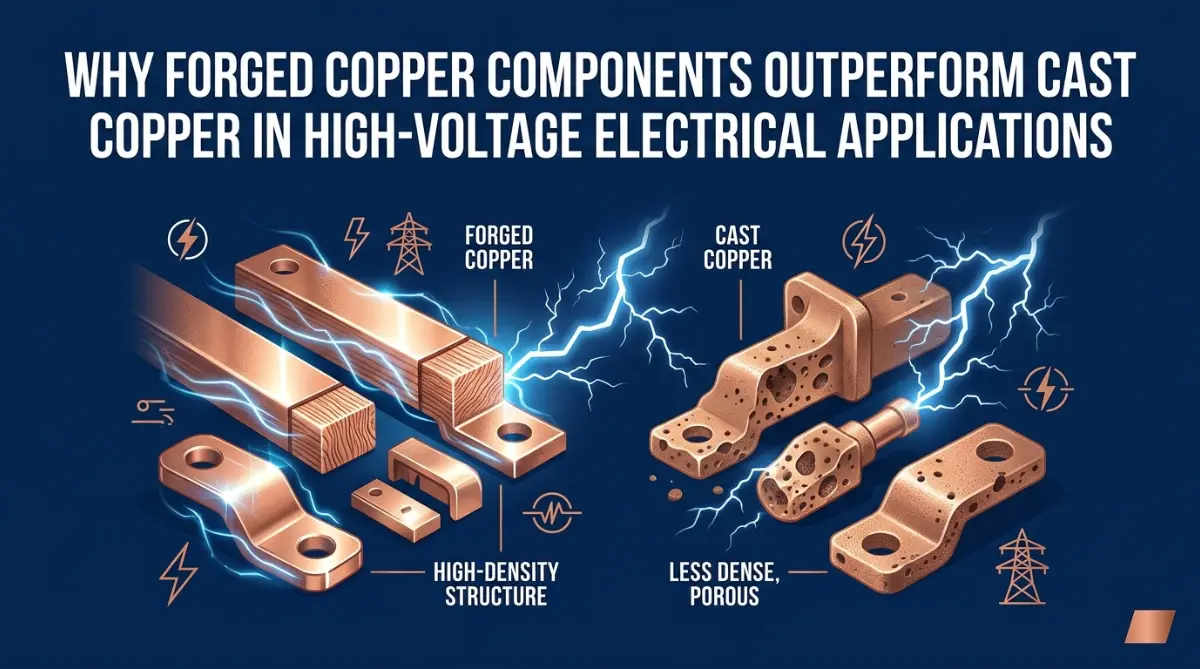
- Fewer Internal Defects: The high pressure involved consolidates the metal, eliminating voids and porosity.
- Material Efficiency: Closed die forging produces near net shape parts, drastically reducing material waste compared to machining from solid bar stock.
- Predictable Performance: Consistent mechanical properties make forged parts ideal for critical load-bearing applications.
Advantages of Casting
- Unrivaled Geometric Freedom: Easily creates complex internal passages and intricate shapes.
- Size Flexibility: Can produce components weighing a few ounces up to hundreds of tons.
- Tooling Cost Versatility: Sand casting patterns are relatively cheap, making it accessible for shorter production runs.
Advantages of CNC Machining
- Ultimate Precision: Can easily hold tolerances tighter than ±0.001 inches.
- No Tooling Lead Time: You don't have to wait weeks for dies or molds to be cut; you just need a CAD file and raw material.
- Excellent Prototyping: The absolute best method for creating functional prototypes or short-run custom parts before investing in forging dies.
Limitations of Each Process
No process is perfect. Understanding the constraints is just as important as knowing the benefits.
- Forging Limitations: High initial tooling costs make it cost-prohibitive for small batch production. It also struggles with undercuts, thin walls, and complex internal cavities.
- Casting Limitations: Lower tensile strength and the risk of internal defects (porosity) disqualify it from many high-pressure or impact-heavy applications. Surface finish often requires secondary machining.
- CNC Machining Limitations: High production costs per unit due to machine time. Substantial material waste drives up the cost when working with expensive alloys like titanium or specialty stainless steels.
Industry-Wise Recommendations
Which manufacturing process should you choose? It heavily depends on your sector's specific demands.
- Automotive: Forging for load-bearing components like steering knuckles, connecting rods, and axle components; casting for housings and brackets; machining for precision bores and mating surfaces.
- Railway: Forged couplings and draft gear components for fatigue resistance under constant cyclic loading.
- Defense: Forging for structural and load-bearing hardware where reliability under stress is non-negotiable, often paired with precision machining for final tolerances.
- Agriculture: Forged implements and linkage components that need to withstand shock loading and repeated stress in the field.
- Oil & Gas: Forged fittings and valve components for pressure-retaining parts, where fatigue life and leak-tight tolerances both matter.
- Construction: Cast components for equipment housings, forged components for structural pins and load-bearing hardware.
- Industrial Machinery: A mix of casting for housings and forging or machining for precision-fit rotating components.
- Aerospace: Forged brackets and structural fittings for the strength-to-weight ratio aerospace demands, finished with precision machining to meet tight tolerances.
- Medical Equipment: Precision CNC machining dominates here, given the tight tolerances and biocompatible material requirements involved.
- Marine: Corrosion-resistant non-ferrous castings and forgings, particularly brass and bronze alloys, for hardware exposed to saltwater environments.
How to Choose the Right Manufacturing Process
When deciding between forging vs casting or CNC machining vs forging, evaluate these critical factors:
- Production Volume: Need 10 parts? Machine them. Need 10,000 parts? Tool up for closed die forging or casting to reduce the per-unit cost.
- Mechanical Requirements: If the part will endure heavy loads, impact, or cyclic stress, forging is the preferred choice. If it's a decorative cover or simple housing, casting is often sufficient.
- Part Geometry: Does the part have complex internal chambers? Casting is the best option. Is it a solid, symmetrical, or structurally critical shape? Forging is ideal.
- Tolerance and Finish: If you need mirror-like finishes and micron-level accuracy straight off the machine, CNC machining is required. (Note: Most industrial forged or cast parts undergo localized precision machining as a secondary operation.)
- Lead Time: If you need parts in two weeks, CNC machining from stock material is your fastest option. If you have 8–12 weeks, you can invest in tooling for forging or casting.
Why OEMs Prefer Closed Die Forging for Critical Components
Original Equipment Manufacturers (OEMs) across the globe consistently lean toward closed die forging when specifying critical industrial components. Why? Total Lifecycle Cost Optimization.
While a cast part might be slightly cheaper upfront, the risk of a field failure is higher. A broken steering knuckle or a fractured railway coupling results in massive warranty claims, downtime, and reputational damage.
Closed die forging ensures a much lower failure rate. The controlled deformation refines the grain structure, enhancing the metallurgical properties exactly where the stress will be highest. Furthermore, because it yields a near net shape, OEMs save significantly on secondary machining time and material scrap, balancing out the initial tooling investment quickly over high-volume runs.
Why Choose IQS Engineering Solutions?
Navigating the complexities of industrial component manufacturing requires a partner who understands the deep technicalities of metallurgy, machining, and supply chain efficiency.
At IQS Engineering Solutions, we act as an extension of your engineering team. As a premier forged parts manufacturer in India, we specialize in high-quality closed die forging, precision CNC machining, and comprehensive custom manufacturing for global OEMs.
We don't just take an order; we provide material selection guidance, design optimization, and process recommendations. Whether it's aluminum forging, brass forging, or steel forging, our facilities boast advanced manufacturing capabilities alongside rigorous in-house quality inspection. With complete material traceability and adherence to international quality standards, we ensure your components are delivered on time, to spec, and built to last.
Frequently Asked Questions
1. Is forging stronger than casting?
Yes. Forging applies extreme pressure to solid metal, aligning its internal grain structure with the shape of the part. This eliminates internal voids and creates exceptional tensile and fatigue strength, whereas casting often suffers from porosity and a random grain structure.
2.When should CNC machining be used?
CNC machining should be used for low-volume production, rapid prototyping, parts requiring extremely tight dimensional tolerances (±0.001"), or when producing geometries from specialized alloys that are difficult to forge or cast.
3.Is casting suitable for high-load applications?
Generally, casting is not recommended for high-impact or cyclical load applications due to the risk of internal micro-shrinkage and porosity. For load-bearing parts like axles or gears, forging is the superior choice.
4.Which process is best for aluminum components?
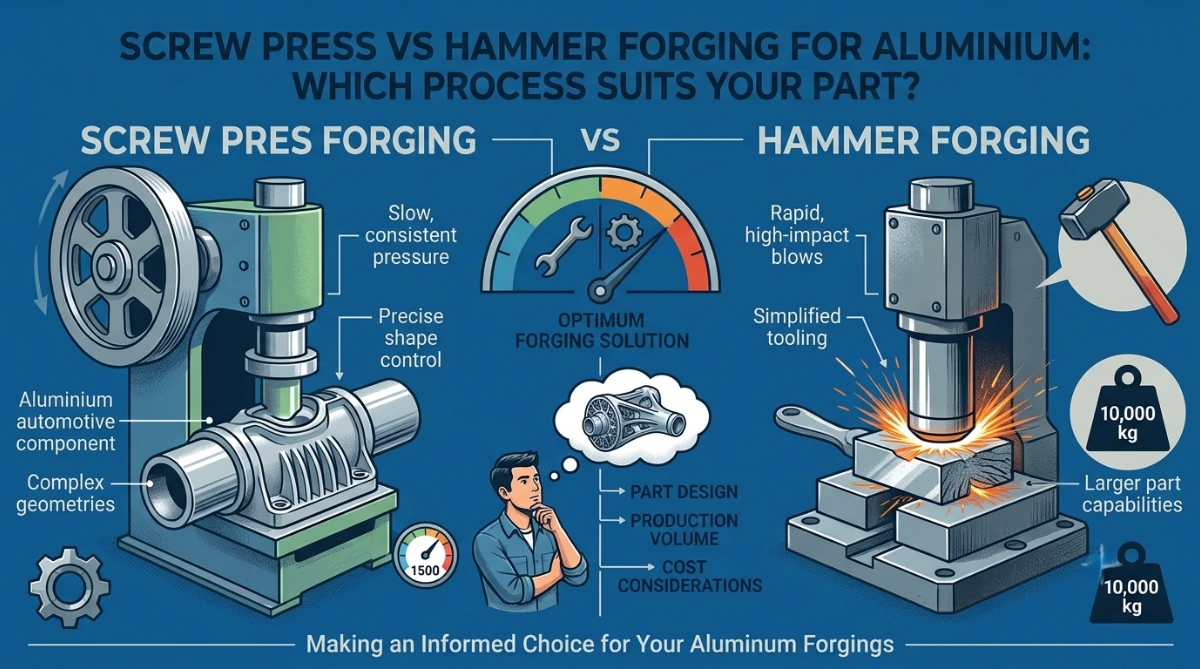
For structural aerospace or automotive parts, aluminum forging is ideal due to its high strength-to-weight ratio. For complex housings or engine blocks, aluminum die casting is preferred. CNC machining is best for custom or prototype aluminum parts.
5. How do OEMs choose a manufacturing process?
OEMs evaluate the part's mechanical stress requirements, complexity (internal vs external features), production volume, and budget. They often consult with manufacturing experts during the design phase to balance performance with production efficiency.
Conclusion
There is no universally "best" manufacturing process, only the one that best fits your part's performance requirements, production volume, budget, and material characteristics. Forging delivers unmatched strength and fatigue resistance for load-bearing components. Casting offers geometric freedom and cost efficiency for complex shapes. CNC machining delivers precision that neither of the other two processes can match on its own and often plays a supporting role in finishing forged or cast parts.